

Slovenia on the UN Security Council: two years of responsible, visible and principled engagement
During its two-year term, Slovenia has proven…
Today, the UN Security Council convened for Slovenia’s signature event — an open debate on Leadership for Peace. The debate, in which 80 UN Member States participated, focused on the challenges facing the UN in today’s geopolitical environment, as well as on the UN we want in the future. Member States also addressed the role of the next Secretary-General, who will be appointed by the UN General Assembly next year.
The debate was a logical continuation of the one organized by Slovenia during its first Presidency of the Council in September 2024. While last year’s discussion focused on the relevance of the Charter and the UN, including of the Security Council, this year – marking the Organization’s 80th anniversary – attention turned to empowering the UN for the future and shaping its future leadership. Through this debate, Slovenia sought to explore ways to guide the UN amid the multiple complex crises, geopolitical instability, erosion of a rules-based world order and its growing financial crisis.
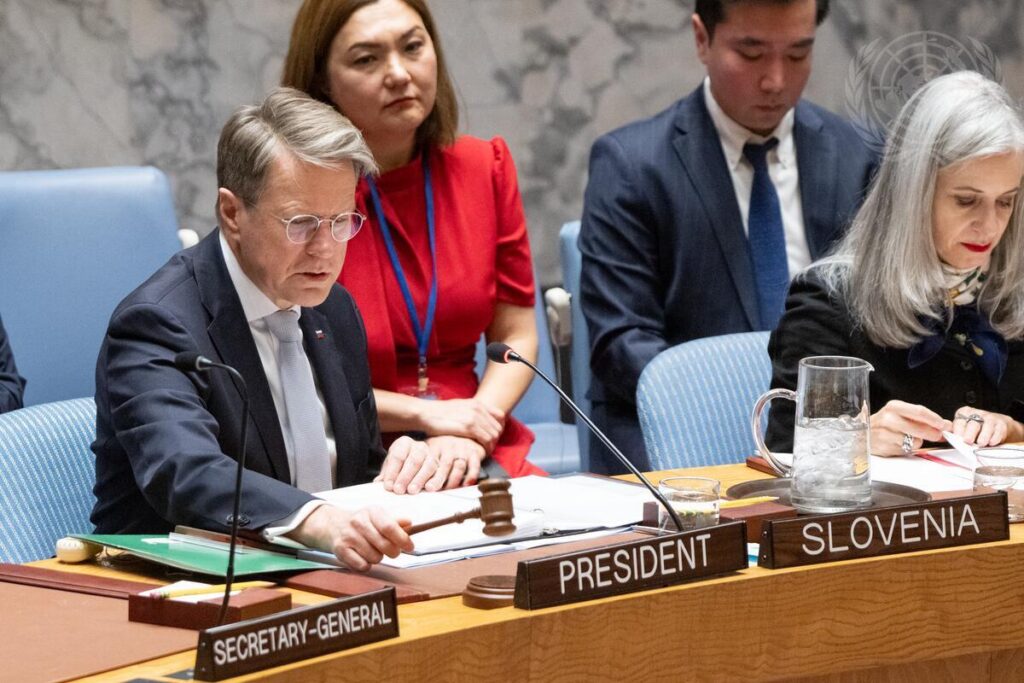
Speaking on behalf of Slovenia, Ambassador Samuel Žbogar emphasized that there is no alternative to the United Nations, which must remain a cornerstone of effective multilateralism. “We need a UN that is effective in addressing global threats and capable of acting swiftly and decisively, particularly in prevention,” he said, underscoring that the Organization must reflect not only the aspirations of its Charter but also the urgency demanded by today’s interconnected crises.
Given the abuses and violations of international law — which serves as a bulwark against war crimes, crimes against humanity, genocide — it is crucial for the UN to remain its guardian. At the same time, the Organization must become more inclusive and legitimate, as its Security Council no longer reflects today’s political or demographic realities. As a unique global forum, the UN must continue to adapt to fulfill its mandate, which requires both adequate political backing and financial resources. “No reform can succeed if Member States do not meet their financial obligations,” Ambassador Žbogar underlined.
Turning to the future leadership, Žbogar stated that the next Secretary-General “must be able to de-escalate tensions and mediate conflicts — serving as an honest broker and a peacemaker.” This requires exceptional diplomatic skill, neutrality, and political courage.
In Slovenia’s view, the Secretary-General carries significant moral authority, serves as a guardian of the UN Charter, and is a manager, capable of navigating complex systems and advancing reforms. Moreover, in its 80-year history, the UN has never been led by a woman — a gap that must be addressed. “Having a woman leader is not just about symbolism; it is also about our credibility,” stressed Žbogar.
In closing, Slovenia called for an alliance for peace, noting that even the best candidate cannot succeed alone. The UN, therefore, needs a movement to build the support that real leadership requires.
During its two-year term, Slovenia has proven…
In its final month as a member of the UN Security Council, Slovenia held the Presidency…
In December 2025, during its Presidency of the UN Security Council…