

Slovenia on the UN Security Council: two years of responsible, visible and principled engagement
During its two-year term, Slovenia has proven…
Today, the UN Security Council addressed conflict-related food insecurity. Slovenia, serving as the UNSC Informal Co-focal Point on Conflict and Hunger alongside Guyana, called for respect for international law, stronger prevention, accountability, and decisive Council action. As Deputy Secretary-General Amina Mohammed stressed, war and hunger are often two faces of the same crisis.
“Armed conflict drives acute food insecurity in 14 of the world’s 16 hunger hotspots. Last year, 295 million people faced acute hunger — 14 million more than the year before,” the Deputy Secretary-General noted, underscoring a grim global reality. For the first time ever, the world is witnessing two famines unfolding simultaneously — in Gaza and Sudan. Urgent attention is also needed in Yemen, South Sudan, eastern DRC, Mali, Burkina Faso, the Central African Republic, Somalia, Haiti, Afghanistan, and beyond.
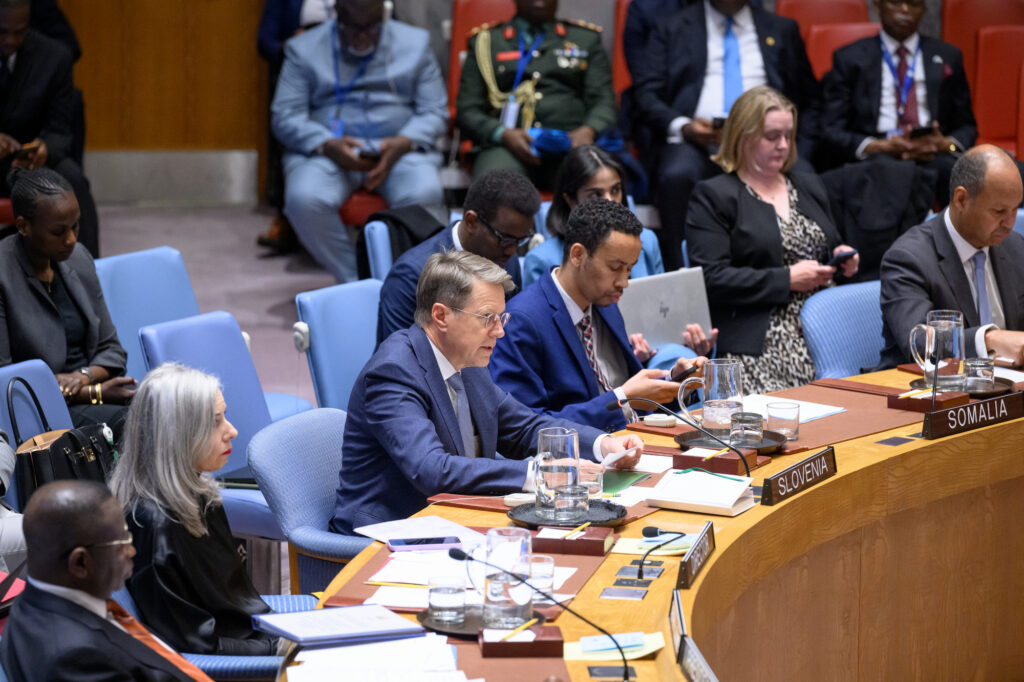
With widespread violations of international humanitarian law — including the prohibition against starvation as a method of warfare — enhancing global respect for international humanitarian and human rights law is essential. “This is the clearest tool we have to prevent conflict-driven hunger,” emphasized Ambassador Samuel Žbogar. He warned that “when starvation is used as a weapon with impunity in one conflict, respect for international humanitarian law erodes in all others,” contributing to unprecedented levels of starving civilians.
Slovenia also urged the Security Council to fully use the tools at its disposal. “This Council should systematically rely on regular reporting and early-warning data,” the Ambassador added. The UN and its partners — especially the Global Network Against Food Crises — must therefore continue coordinated efforts, with IPC analyses remaining a trusted and protected source.
In closing, Ambassador Žbogar reminded the Council that famine does not end when global attention shifts elsewhere. The most vulnerable — including children, women, persons with disabilities, older persons, and displaced — face long-term health and socioeconomic consequences. To build a future where food is never again used as a weapon, we must strengthen accountability, protect civilians, and use the authority of the Security Council to act.
During its two-year term, Slovenia has proven…
In its final month as a member of the UN Security Council, Slovenia held the Presidency…
In December 2025, during its Presidency of the UN Security Council…