

Slovenia on the UN Security Council: two years of responsible, visible and principled engagement
During its two-year term, Slovenia has proven…
In November, the Security Council voted on a resolution on Gaza, proposed by the US, and addressed several issues, mostly in Africa and the Middle East. The Sierra Leone Presidency organized three signature events—open debates on small arms and light weapons, and on conflict-related food insecurity, and a briefing on climate and security—in which Slovenia called for stronger civilian protection and compliance with international law. Together with its partners, Slovenia also requested a briefing on Ukraine. Finally, the Security Council and the General Assembly adopted twin resolutions on the 2025 Peacebuilding Architecture Review, co-facilitated by the Permanent Representatives of Slovenia, Samuel Žbogar, and of Egypt, Osama Abdelkhalek.
On November 17, the Security Council adopted a resolution on Gaza, proposed by the US, which focused on the operationalization of the Comprehensive Plan to End the Gaza Conflict previously presented by President Trump. As explained by Ambassador Samuel Žbogar, Slovenia voted in favor of Resolution 2803 because it represents the best way to ensure that the current ceasefire leads to permanent peace, enjoys strong support from regional countries and Palestine, and because it reinforces the Security Council’s supervisory role in implementing the Gaza Peace Plan.
At a regular meeting on the Palestinian question, Slovenia urged the full and good-faith implementation of Resolution 2803. The ceasefire in Gaza must also extend to the West Bank, where violence against Palestinians continues to escalate at alarming levels. The Ambassador condemned settlers’ violence and emphasized that genuine accountability is essential for meaningful healing for Palestinians.

The unanimous adoption of twin resolutions on the review of the UN Peacebuilding Architecture by the Security Council and General Assembly shows a further dedication by Member States to conflict prevention and peacebuilding on the ground. Co-facilitated by Permanent Representatives Samuel Žbogar of Slovenia and Osama Abdelkhalek of Egypt, the resolutions reaffirm the collective commitment to cooperating, building and sustaining inclusive peace, and to saving succeeding generations from the scourge of war.
Slovenia—on behalf of Denmark, France, Greece, the Republic of Korea and the United Kingdom—requested a Council meeting in response to Russia’s intensified attacks on civilians and energy infrastructure in its war against Ukraine. Deputy Permanent Representative Ondina Blokar Drobič condemned the latest strike in Ternopil. She also expressed concern over the sharp rise in civilian casualties—who continue to bear the brunt of Russia’s intensifying aerial campaign—and called for a full, immediate and unconditional ceasefire.
Addressing the latest developments in Syria, Slovenia welcomed the adoption of Resolution 2799 as a strong signal of support for Syria’s recovery, reconstruction and stabilization. An inclusive political transition requires the Syrian authorities to persue a national dialogue that involves all Syrians. Additionally, Ambassador Žbogar underscored the urgency of meeting humanitarian needs, noting that—according to OCHA—16 million people require assistance and hundreds of thousands remain displaced. While the Assad regime has fallen, the humanitarian crisis is far from over.

At the open debate on food insecurity Slovenia – as a Focal Point on Conflict and Hunger alongside Guyana – voiced alarm over rising conflict-related hunger. According to the UN, 295 million people faced acute hunger last year, 14 million more than the year before. Ambassador Žbogar called for stronger prevention, more decisive Council action, and full respect for international law. “Armed conflict does not inevitably lead to famine; disrespect for international humanitarian law does,” he underlined, noting that compliance with international law remains the most effective tool to prevent conflict-driven hunger.
On November 6, the International Day for Preventing the Exploitation of the Environment in War and Armed Conflict, the Security Council held an open briefing focused on how wars affect not only people, but also the environment and the planet itself. Slovenia emphasized the importance of full respect for international humanitarian law and of strengthening efforts to prevent environmental destruction during conflicts. Ambassador Žbogar also reminded the Council that Slovenia, alongside with partners, launched the Global Alliance to Spare Water from Armed Conflicts — an initiative focused on protecting water systems that sustain life.
During an open debate on small arms and light weapons (SALW), Slovenia stressed the need for enhanced action to protect civilians and promote responsible arms management. “Every minute, somewhere in the world, a life is taken by a small arm. These weapons are easy to find, easy to hide, easy to use, and too often impossible to trace,” underscored Ambassador Žbogar. Given the devastating human cost of illicit SALW, he stated that effective prevention, tracing and accountability are essential to stop these weapons from fueling violence and instability.
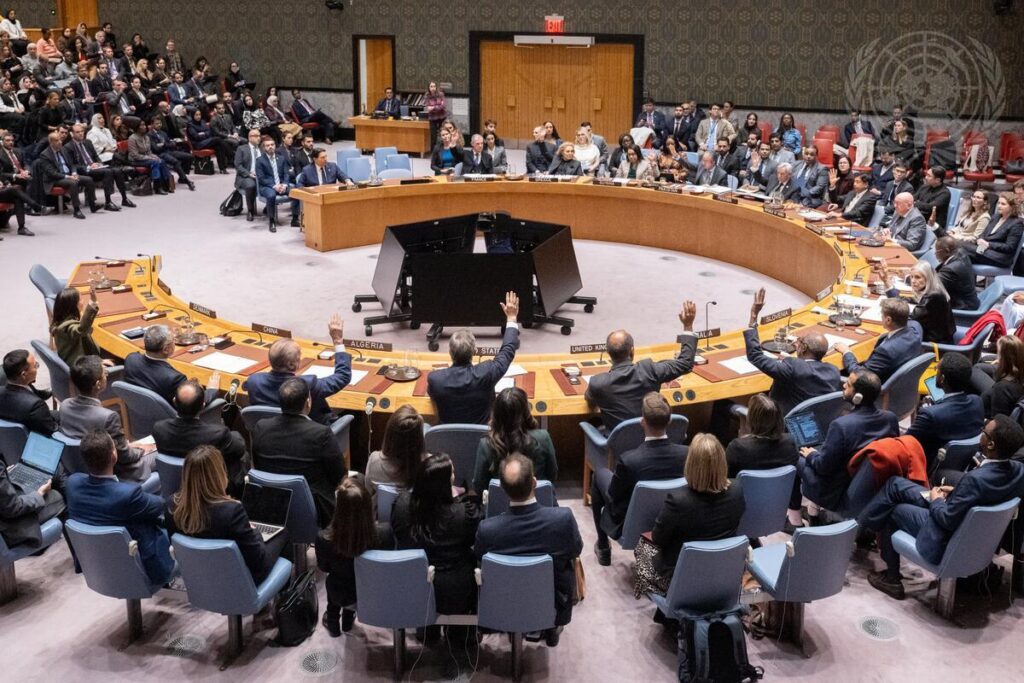
On 12 November, the Security Council and the General Assembly held by-elections for the International Court of Justice. Professor Phoebe Okowa of Kenya was elected as a judge of the Court.
In November, the Security Council also lifted the sanctions on Syrian President Ahmed al-Sharaa and Interior Minister Anas Khattab arising from Resolution 1267. The UNSC adopted a press statement on the situation in the DRC and extended the mandates of the MINUSCA mission in the Central African Republic, the 2140 Yemen sanctions regime, the UN Interim Security Force for Abyei (UNISFA), and the authorizations to uphold the arms embargo in Libya through vessel inspections.
During its two-year term, Slovenia has proven…
In its final month as a member of the UN Security Council, Slovenia held the Presidency…
In December 2025, during its Presidency of the UN Security Council…